
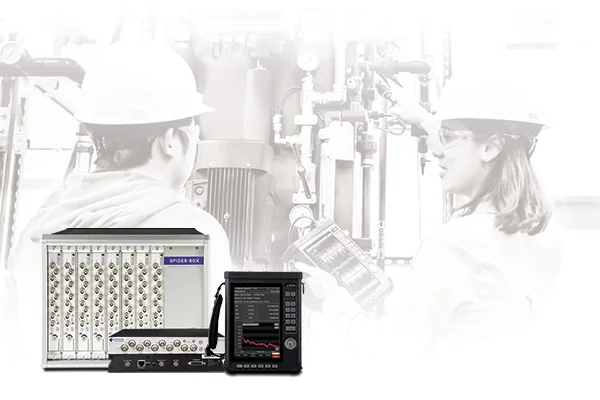
Crystal Instruments offers high channel and handheld machine condition monitoring solutions.
Machine Condition Monitoring
Smooth running process machinery buoys and maintains the world’s economy. Products ranging from gasoline and chemicals to paper and steel are produced by continuous manufacturing processes. Nuclear, coal-fired, natural gas fueled, hydroelectric, wind powered or tidal-driven power generation plants must produce continuously. Unexpected stoppages are the anathema of all these industries and vibration monitoring is a proven means of preventing them.
Effectively monitoring the operating health and rapidly diagnosing the occasional mechanical woes of production machines is a vital survival mission in today’s competitive business world. Today’s monitoring technology has divided to follow two equally important strategic paths. Expensive plants and critical machines are continuously monitored by permanently installed systems. Less critical machines (and plants monitored by external contractors) are protected by routed periodic measurements made using handheld data collector/analyzers guided by advanced database and analysis software. Crystal Instruments produces innovative offerings in support of both strategies.
Continuous Monitoring Solutions
Web-Based Continuous Condition Monitoring
Continuous measurement of shaft-to-case gaps
Continuous measurement of case accelerations
Track bearing temperatures, lubricant debris
Share data anywhere, anytime via Internet
Local recording to solid-state mass memory
Automatic record-on-alarm operation
Periodic Monitoring Solutions
Route-Based Periodic Condition Monitoring
Design and manage monitoring relational database
Measure consistent error-free data along route
Make voice-annotated data recordings of problems
Upload data to PC; generate alarms and reports
Make at-machine diagnostic measurements
Perform 1 and 2 plane rotor balancing
Machine Condition Monitoring Applications
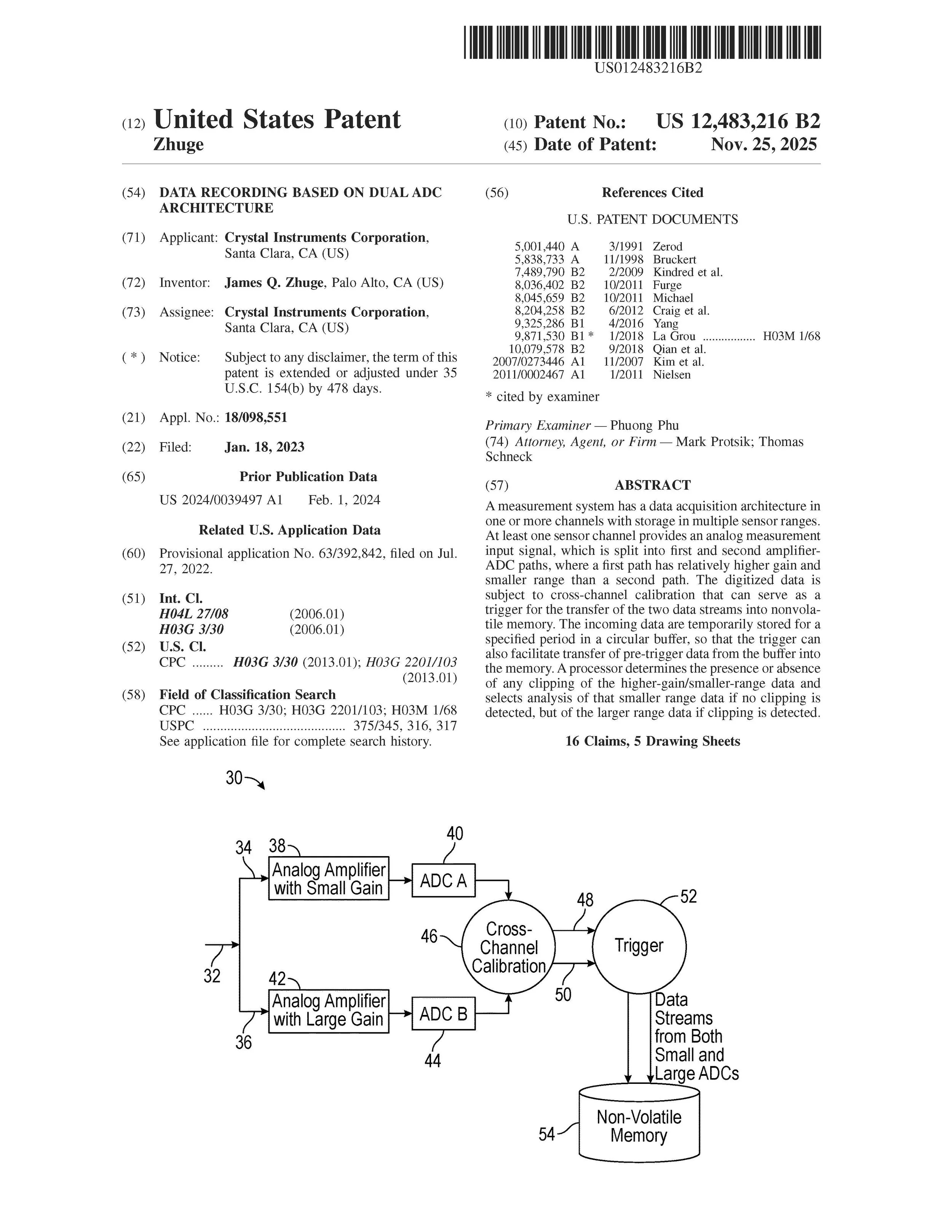
Santa Clara, CA - November 25, 2025 — Crystal Instruments Corporation, a global leader in vibration testing, dynamic measurement, and data acquisition technologies, today announced that the United States Patent and Trademark Office has officially granted U.S. Patent No. 12,483,216 B2, titled “Data Recording Based on Dual ADC Architecture.” The patent is credited to inventor James Q. Zhuge, founder and CEO of Crystal Instruments.

Digital filters are powerful tools utilized during the data conditioning phase to analyze signals. These filters empower users to augment signal processing capabilities by integrating them with other data conditioning modules, thus generating advanced post-analysis functionalities. Among the primary types of real-time digital filters are the Decimation filter, the FIR (Finite Impulse Response) filter, and the IIR (Infinite Impulse Response) filter.

We recently republished a classic white paper about dynamic signal analysis.

Our team is thrilled to announce the 11.1 version of Engineering Data Management (EDM) software. Packed with a range of new features and improvements, this update is designed to elevate the user experience.

DSA is often referred to Dynamic Signal Analysis or Dynamic Signal Analyzer depending on the context. DSA uses various technologies for digital signal processing. Among them, the most fundamental and popular technology is based on the so-called Fast Fourier Transform (FFT). The FFT transforms the time domain signals into the frequency domain. To perform FFT-based measurements, it is important to understand the fundamental issues and computations involved.

Using purpose driven equipment like the CoCo-90X, an advanced battery powered dynamic signal analyzer that scales up to 16 input channels, IVC Technologies can collect more input channels than traditional walk around data collectors and can record time streams for several minutes or longer to observe and capture data from the entire raising and lowering of the bridge in one data set. With 16 channels, vibration data can be collected on the motors, gearboxes, and sheave bearings synchronously. This both reduces the overall collection time and increases the ability to properly access the synchronous data.

The latest release of version 2.2 CoCo Software includes notable updates such as support for 1 hz resolution, an IEPE powered tachometer, Waterfall & Colormap signal reviews, and the ability to sync VDS user profiles on a CoCo device.

The auto-wake feature is a new and powerful function provided in EDM 10.0 software. This feature allows users to set up a wake-up alarm for Spiders to power on, perform a test, and power off. Users can upload up to 8 predefined tests and run these in Black Box mode (without a connection to a computer or network to run). This convenient mode allows users to acquire data autonomously or with little user intervention.

Some data acquisition applications will inevitability run into one of the most common problems of the information age: information overload. Today, modern DAQ systems, such as the highly versatile Crystal Instruments Spider product line, can store significant amounts of vibration data. Now, memory limitations are significant. However, sifting through large amounts of data in order to capture a small transient event is undesirable.

Crystal Instruments is excited to announce the release of EDM 10.0, the latest software version for all Spider and CoCo products serving advanced and fundamental industries in addition to furthering academic advancements.

Founded in 1996, Crystal Instruments designs and manufactures instrumentation products for machine vibration monitoring, dynamic measurement, and environmental testing. The products are developed in Silicon Valley and our modern lab in North Carolina. Crystal Instruments products are thoroughly tested on a variety of vibration shakers and environmental chambers in our lab during the design phase to meet the extreme requirements of military and aerospace applications.

Crystal Instruments is pleased to announce the release of EDM 9.1, the most reliable and powerful version available from Crystal Instruments.
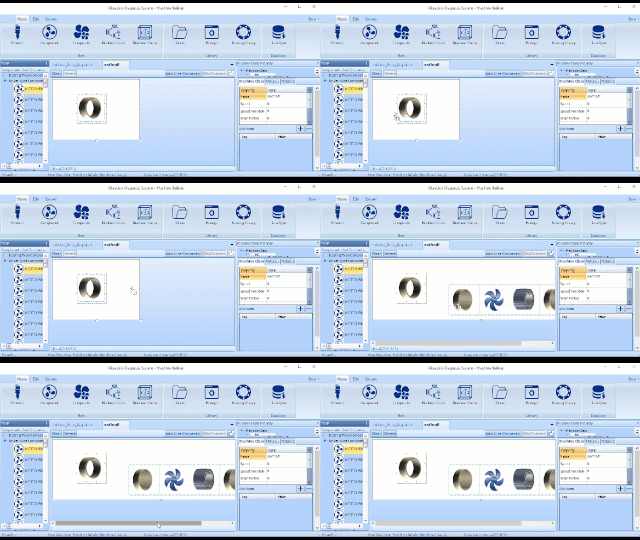
The Vibration Diagnostic System (VDS) software provides several important tools for machine predictive maintenance data collection, analysis and management. When synchronized with a CoCo handheld analyzer, the system integrates factory and route structuring, machine information, vibration data and analysis all in one place. The diagnostic algorithms are based on the concept of a machine model, and VDS provides a powerful tool for building machine models. This tool is called the Machine Builder.

The accurate measurement of micro-vibrations is the first step of successful vibration contamination control. According to generic vibration criteria for vibration sensitive equipment, the RMS velocity of vibration criterion is from 50 to 3.1 μm/s (2000 to 125 μin/s). To measure such small amplitudes, high sensitivity and low frequency sensors must be used. Crystal Instruments provides the Wilcoxon WR 731 and PCB 393B31 accelerometers with the CoCo-80X data analyzer for this application.

Off Route measurements are linked to machines in the database using a system called Job Management. When taking Off Route data, the measurements are stored under jobs and each job is assigned to a machine. The job-machine relationship is maintained after syncing the CoCo with VDS, so Off Route measurements are automatically associated with the correct machines.

Featuring the highest sampling rate provided in the industry at 256 kHz. Handheld battery powered system with wired & wireless network options and 20V input range. Sync between multiple devices. Choose the convenient portable model or industrial model for permanent mounting.
The Spider-20H, Spider-20HE, and Spider-20i received a hardware upgrade to support an impressive 256 kHz samping rate on all 4 input channels. It is the highest sampling rate offered in the market of compact analyzers. The high sampling rate is especially beneficial for measuring high orders and transient capture in blast tests, pyroshock events, drop shock tests, crash tests, etc.
In addition to the high samping rate, the input range is expanded to 20V to capture larger signals.

When designing and testing materials and products it is essential to understand its material properties and how it reacts to the forces and loads applied to it. The deformation a DUT experiences when a force is applied is called strain. Strain is the ratio of the change in length of a material to the original length. Strain can be positive (tensile) or negative (compressive).

The CoCo-70X is Crystal Instruments’ latest handheld vibration analyzer, designed specifically for the machinery Predictive Maintenance (PdM) community. The four-channel analyzer features an IP-67 rating and is ideal for a wide range of industries including petrochemical, paper, steel and other metals, automotive, aviation, aerospace, electronics and military.

What is WBV used for?
Many industrial workers are subjected to whole-body vibration on a regular basis, which can have a noticeable effect on their health. Employers are expected to provide an accurate risk assessment of whole-body vibrations resulting from use of their equipment. WBV measurements are therefore necessary to provide access to vibration emission data. The availability of accurate vibration emission data is essential to the process for employers completing a vibration risk assessment.

Remote Condition Monitoring (RCM) by Crystal Instruments is designed for the remote monitoring of equipment or structures that are inaccessible to configure within a local network. Common applications and examples of remote condition monitoring include the monitoring of vibrations during the transportation of equipment, monitoring vibrations on bridges and structures close to rails or roadways, and monitoring vibrations caused by rotating windmills on the ground.

I’ve always wondered why some instruments in the market set their hardware input range to 10 V. Perhaps the hardware designer for these instruments possessed ten fingers and chose 10 V out of convenience. I can imagine their bosses eagerly approving the use of 10 V as well, because they too have ten fingers!

Machine condition based monitoring plays an important role in securing the stealth of the submarine, as any vibration related tone passed through the hull to the outside world could betray the vessel. All onboard equipment must be meticulously monitored and maintained.

The Spider series of dynamic signal analyzers by Crystal Instruments welcomes its newest product, the Spider-20, which at 5 x 4 inches and 18 ounces is the most compact instrument in the product line.
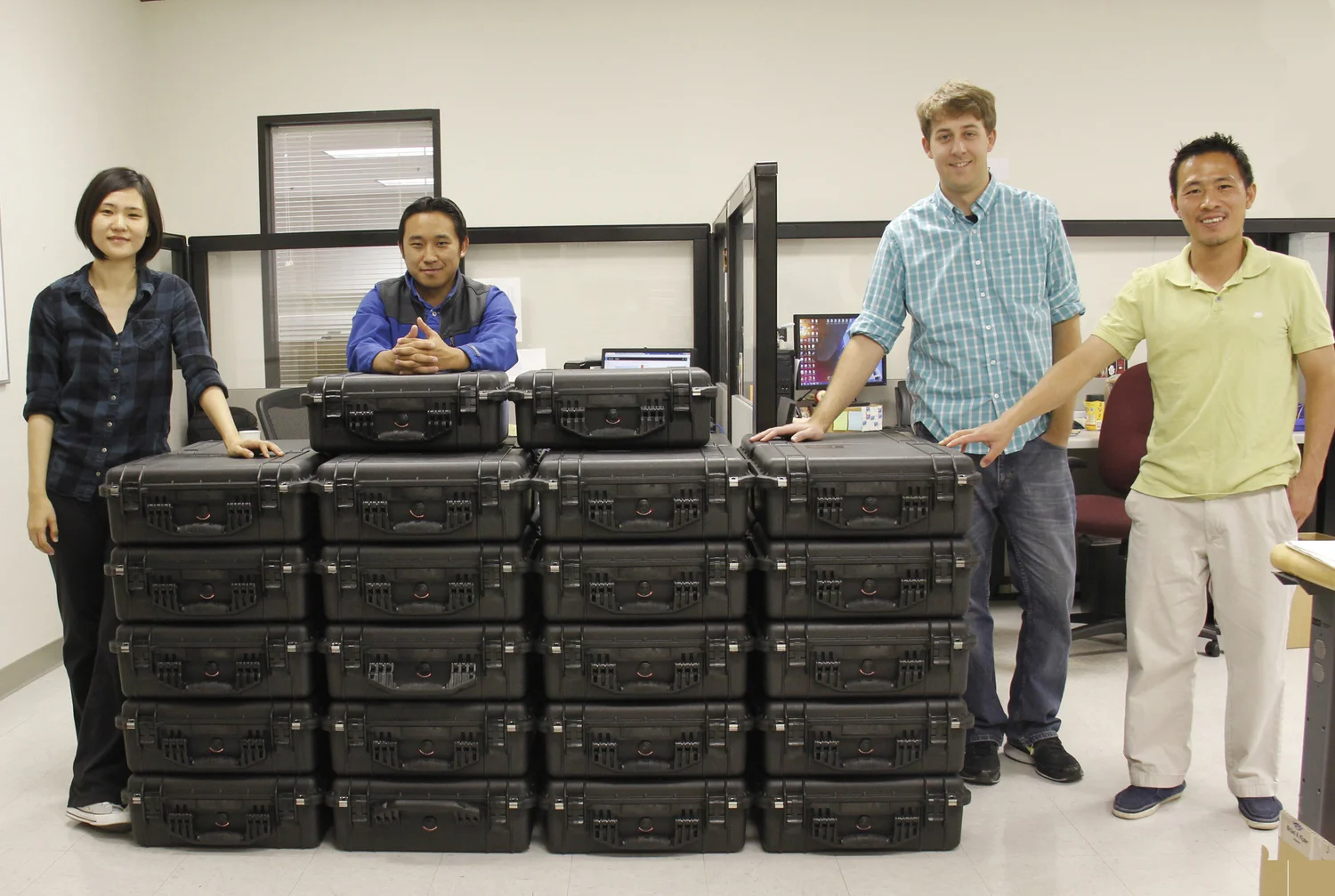
Crystal Instruments shipped over fifty CoCo-80 handheld vibration monitoring devices in the month of June 2015. Used for preventative maintenance, vibration testing, and machine monitoring, the flexible software of the CoCo-80 allows technicians to easily take data through customized applications.

The short answer is, “a lot!” DSA (dynamic signal analyzer) users will immediately be able to do more of what they already do, faster and easier. VCS (vibration control system) users will discover new and safer ways of testing products to requirement specifications.


Speed reducers and other gearboxes are common industrial components. Monitoring their case vibration with accelerometers is an effective means of detecting problems within. To effectively diagnose these important mechanical elements, you need to understand the geometric details of their construction. Most importantly, you need to know the arrangement of shafts and the number of teeth on every gear within your transmission.

The CoCo-80 was an ideal choice as a portable vibration data collector for monitoring the health of the rotating machinery, specifically, HVAC equipment. The CoCo-80 weighs in at only 3.5 lbs, features an intuitive interface, and is rugged enough to operate in extreme conditions.

One of the breakthrough features of the CoCo-80, Spider-80X, and Spider-81 is their outstanding dynamic range performance of 160 dBFS. This kind of performance has never before been achieved with such small, portable, and low cost devices. The main advantage of this high dynamic range is that it eliminates the need to adjust the input gain/range settings on the front end, thus simplifying the setup and measurement process. Both full scale 10 volt signals and very small microvolt signals are measured at the same time with no adjustments. This capability makes setup and testing more simplified in comparison with an instrument capable of only a lower dynamic range.
There are two steps for converting an analog signal into a digital signal – quantization in time (sampling) and quantization of amplitude. Any signal that goes through the sampling process is subject to the effect of aliasing. The common use of the word ‘alias’ is used to describe a false name or identity, which is similar to how the term is used in signal processing.