
A Mixed Impact Shaker MIMO Test Technique (MIS-MIMO)
ABSTRACT | DOWNLOAD PAPER
Modal testing involves collecting frequency response functions using either an impact or shaker excitation technique. Impact testing is often performed due to the ease of the test setup and simplicity of the measurement process. But larger structures may not be adequately excited with single impact excitation locations as the test progresses.
The use of shakers increases the level of complexity of the test and imposes additional considerations and complications when performing shaker testing. While shaker testing can provide a much better control force level and frequency spectrum, the attachment of the shaker and stinger and associated equipment can have an effect on the measured frequency response functions. This becomes more important as more shakers are added to improve the overall measurement system. A multiple input multiple output (MIMO) test is used to collect all the frequency response functions at the same time to minimize inconsistencies in the data collected. However, there are times when the location for the measurement desired cannot be accomplished with shaker attachment due to physical inaccessibility; this can be especially true with impedance modeling.
Due to the pros and cons of the impact and shaker testing techniques mentioned above, a unique Mixed Impact Shaker MIMO test technique was developed and is called MIS-MIMO. The test consists of a traditional MIMO shaker setup but with the addition of an impact at additional locations which are not easily accessible for shaker testing. In addition, the impacts are applied in a multiple burst strategy similar to the burst random excitation used for shakers. And the impacts can actually be performed with a handheld inertial shaker with a force gage and hammer tip for better signal input specification.
The results of the complete MIS-MIMO test are described in the paper with all associated measurements to show the use of the technique; the technique was successfully deployed on two separate measurement systems with different complexity.
Keywords: MIMO, Impact Technique, Shaker Technique
Republished with permission from Dr. Pete Avitabile and SEM (Society for Experimental Mechanics)
INTRODUCTION
Impedance modeling applications for system modeling have a very strict requirement that all the frequency response functions must be consistently related [1-3]. At times, there are a large number of drive point and transfer frequency response measurements that must be acquired in order to perform the system modeling process. When these measurements are collected piece-meal or in several separate testing configurations, there is a certain possibility that the measurements may not be consistently related. This becomes even more exaggerated when some of the measurements come from shaker excitation and some come from impact measurements. Shaker testing becomes more critically necessary when the structure is larger and more complicated and single impact excitation cannot adequately acquire frequency response measurements with sufficient accuracy.
A recent application of system modeling involved a large set of impedance measurements in order to perform system modeling calculations. In addition, the analysis was performed in order to identify the appropriate forces required for the application of the FINE technique [4-6]. The testing required a large 12x12 force matrix for the development of the input excitation; this was also used to form the experimental modal model for the structure. In addition, there were a total of 36 additional references that were necessary to develop the impedance models required.
While impact measurements might be considered a suitable alternate for all the measurements, the reality was that single impact excitation was not sufficient to obtain highly accurate frequency response functions for all the measurement points required. The acquisition of these shaker measurements alone required much care and attention to acquire the 12 x 12 MIMO test.
In addition to the 12 shaker MIMO test, a large set of impact measurements were required in order to perform the complete set of measurements required; these impact locations were located at points on the structure where attachment of a shaker was difficult if not impossible. These were additional measurement points that were necessary for the impedance model.
However, the impact tests were initially performed with the shakers disconnected from the structure but upon first review, there was a very clear difference between the shaker test results and the impact test results thereby clearly identifying that collection of all the required measurements must be performed at the same time. Additional attempts were made to collect the impact measurements with the shakers attached in both the energized and unenergized states, but the overall results clearly indicated that when all the measurements were assembled into one data base, there were very clear inconsistencies in all the data collected from separate measurement campaigns.
An alternate approach is necessary in order to obtain a complete set of consistent frequency response functions. A new testing approach to achieve these goals is described next.
AN ALTERNATE UNCONVENTIONAL TEST APPROACH
Because the frequency response functions all need to be consistently related, a combined shaker MIMO test in conjunction with an impact test was considered as a possibility. Basically, a traditional MIMO test with multiple shakers would be performed but at the same time, an impact hammer excitation would be applied to the structure and included as an additional force reference to the shaker force matrix. The shaker test would utilize burst random excitation. While the shaker burst excitation persists, a randomized set of impacts are applied to one of the structure points where force excitation is desired.
In this way, a complete set of applied forces are measured on the structure to develop the input force matrix. As in any MIMO application, all the applied forces need to be uncorrelated to allow for the inversion of the force matrix. In this way a complete and consistently related set of frequency response functions can be acquired.
While an impact hammer is one possible excitation to be used for this approach, another alternate is a small handheld inertial shaker outfitted with a force gage and hammer tip. This can be used in the same manner as the impact excitation discussed above. But one additional benefit is that the burst random excitation can be directly applied to the inertial shaker. Also, the inertial shaker can be very easily positioned to provide excitation at many different points and directions on the structure. As the burst random excitation starts, the inertial shaker hammer tip can be used to excite the structure, whether it be held on the structure for the compete duration or intermittently held on the structure while the burst random excitation persists. However, at the end of the burst, the shaker must not continue to be in contact with the structure.
In order to illustrate the implementation of this MIS-MIMO technique, two separate structures were used – one was a small academic frame structure and the other was a larger frame structure. Each are described separately next along with the results of the test.
SMALL ACADEMIC FRAME TEST STRUCTURE
A small frame structure is shown in Figure1. The frame was supported with elastic cords to provide a free-free configuration for testing; also shown are 2 shakers, an impact hammer and inertial shaker used for testing with the Crystal Spider data acquisition system (7). The test parameters used a 1024 Hz bandwidth with either 4096 or 8192 spectral lines. No windows were used because the complete measurement was obtained within one sample interval of the FFT process. There were 25 averages made for each set of data collected.
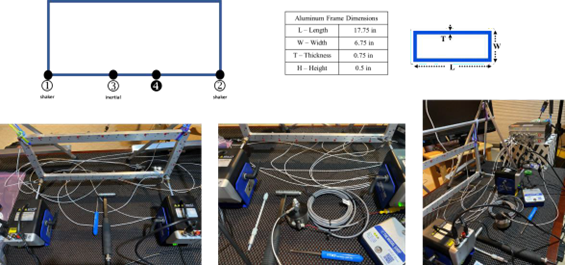
Figure 1: Frame Structure and Test Setup
A series of tests were performed and the results are presented here.
Impact Pt 4 with no shakers attached
A traditional impact test was performed and the measured FRF is shown in Figure 2. The FRF and coherence is considered to be good and an acceptable measurement.
MIMO 2 shaker test at Pt 1 & 2 (with burst random for all shaker tests)
A traditional shaker MIMO test was performed and the measured FRF is shown in Figure 3. The FRF and coherence are seen to be very good for this measurement. However, the results are clearly different when compared to the impact test results shown in Figure 2.
MIMO 2 shaker test at Pt 1 & 2 with 3rd reference at Pt 4 with Burst Random Impacts
The traditional shaker test was augmented with a burst random impact excitation applied and the measured FRF is shown in Figure 4 with the input time forces applied. The impact force was applied for approximately 80% of the time block similar to the MIMO shaker excitation deployed. The FRFs all look very good with very good coherence. So the traditional MIMO shaker test augmented with the burst random impact produced very good results.
MIMO 2 shaker test at Pt 1 & 2 with 3rd reference at Pt 3 with Inertia Shaker excited with Burst Random
The traditional shaker test was augmented with a burst random signal applied to the inertial shaker and the measured FRF is shown in Figure 5 with the input time forces applied. The impact force was applied for approximately 80% of the time block similar to the MIMO shaker excitation deployed. The FRFs all look very good with very good coherence. Again the traditional MIMO shaker test augmented with the burst random excitation impact excitation with the inertial shaker produced very good results.
MIMO 2 shaker test with 3rd reference at Pt 3 with Inertia Shaker (Burst Random) AND Pt 4 Burst Random Impacts
The traditional shaker test was augmented with a burst random signal applied to the inertial shaker AND with a burst random impact excitation applied and the measured FRF is shown in Figure 6 with the input time forces applied. The impact force was applied for approximately 80% of the time block similar to the MIMO shaker excitation deployed. The FRFs all look very good with very good coherence. In this case the traditional shaker MIMO with the burst random impact excitation with the inertial shaker and the burst random impact excitation also produced very good results.
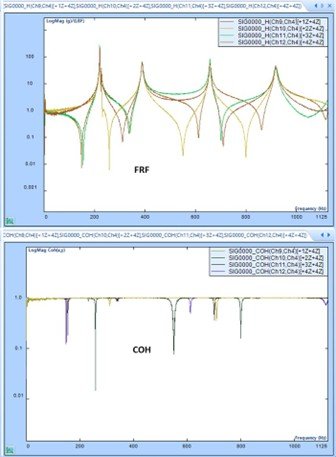
Figure 2: Frame Structure Traditional Impact Test Results – FRF and Coherence
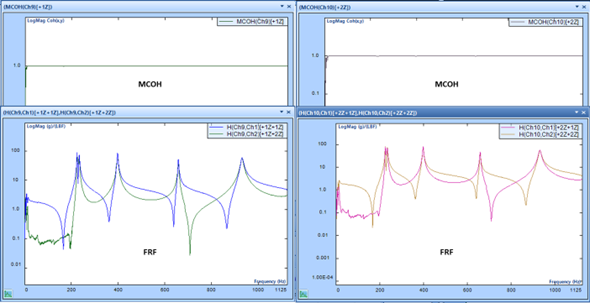
Figure 3: Frame Structure Traditional Shaker MIMO Test Results
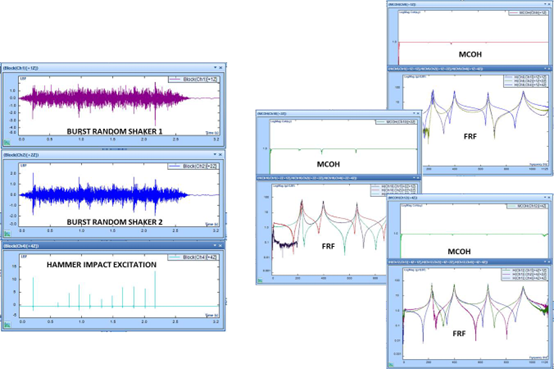
Figure 4: Frame Structure Traditional Shaker MIMO and Burst Random Impact Test Results Time Input Force Input, FRF, Coherence
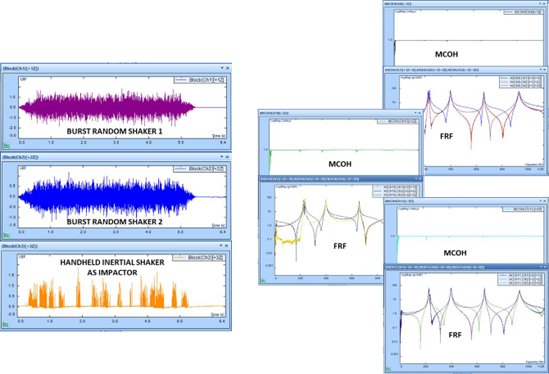
Figure 5: Frame Structure Traditional Shaker MIMO and Burst Random Inertial Shaker Test Results Time Input Force Input, FRF, Coherence
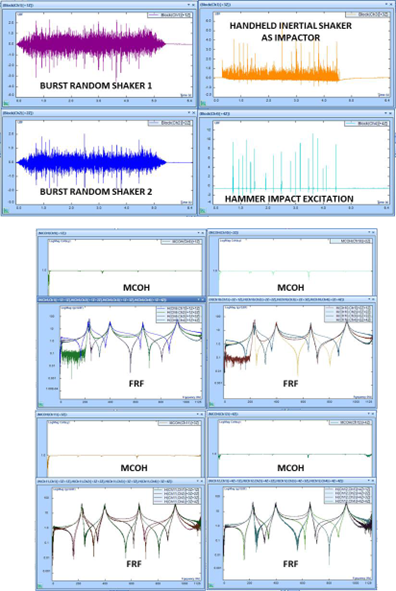
Figure 6: Frame Structure Traditional Shaker MIMO and Burst Random Inertial Shaker and Burst Random Impact Test Results Time Input Force Input, FRF, Coherence
CONCLUSION
A very novel blended impact and shaker MIMO test is presented. The Mixed Impact Shaker MIMO test (MIS-MIMO) provided very good measurements that were not possible with other testing strategies. The resulting frequency response functions were of very good quality as evidenced by the multiple coherence obtained.
This MIS-MIMO technique provides a very unique approach to blending impact and shaker testing in one coherent and consistently related set of frequency response measurements that might typically be required for impedance modeling applications. The particular implementation presented in this paper was directed towards the collection of frequency response measurements necessary for the Fixture Neutralization (FINE) approach to compensate for vibration fixture dynamic interaction with the test articles under evaluation.
REFERENCES
“Experimental Issues Related to Frequency Response Functions for Frequency Based Substructuring”, D.Nicgorski, P.Avitabile, Mechanical Systems and Signal Processing, (10.1016/j.ymssp.2009.09.006), Volume 24, Issue 5, July 2010, Pages 1324-1337
“Conditioning of FRF Measurements for Use with Frequency Based Substructuring”, D.Nicgorski, P.Avitabile, Mechanical Systems and Signal Processing, (10.1016/j.ymssp.2009.07.013), Volume 24, Issue 2, February 2010, Pages 340-351
“Effects of Precise FRF Measurements for Frequency Based Substructuring”, J.Harvie, P.Avitabile, Proceedings of the Thirty-First International Modal Analysis Conference, Garden Grove, CA, Feb 2013
“Force Customization to Neutralize Fixture-Test Article Dynamic Interaction”, J.M. Reyes, P.Avitabile, Proceedings of the Thirty-Sixth International Modal Analysis Conference, Orlando, Florida, Feb 2018
“Adjustment of Vibration Response to Account for Fixture-Test Article Dynamic Coupling Effects”, J.M. Reyes, P.Avitabile, Proceedings of the Thirty-Fifth International Modal Analysis Conference, Garden Grove, CA, Feb 2017
“A Study on the Dynamic Interaction of Shock Response Fixtures and Test Payload”, J.Reyes, P.Avitabile, Proceedings of the Thirty-Fourth International Modal Analysis Conference, Orlando, FL, Feb 2016
Crystal EDM Modal with Spider DAQ, Crystal Instruments, Santa Clara, CA