
Satellite Vibration Testing and Force Limiting at SmallSat 2026
Crystal Instruments attended the 40th Annual Small Satellite Conference (SmallSat 2026), held Aug. 24–28 at the Salt Palace Convention Center in Salt Lake City, Utah. The event brought together thousands of professionals from government, aerospace, industry, and academia to explore technologies supporting small satellite development, qualification, launch, and operation.
SmallSat 2026 Showcases Satellite Testing Technology
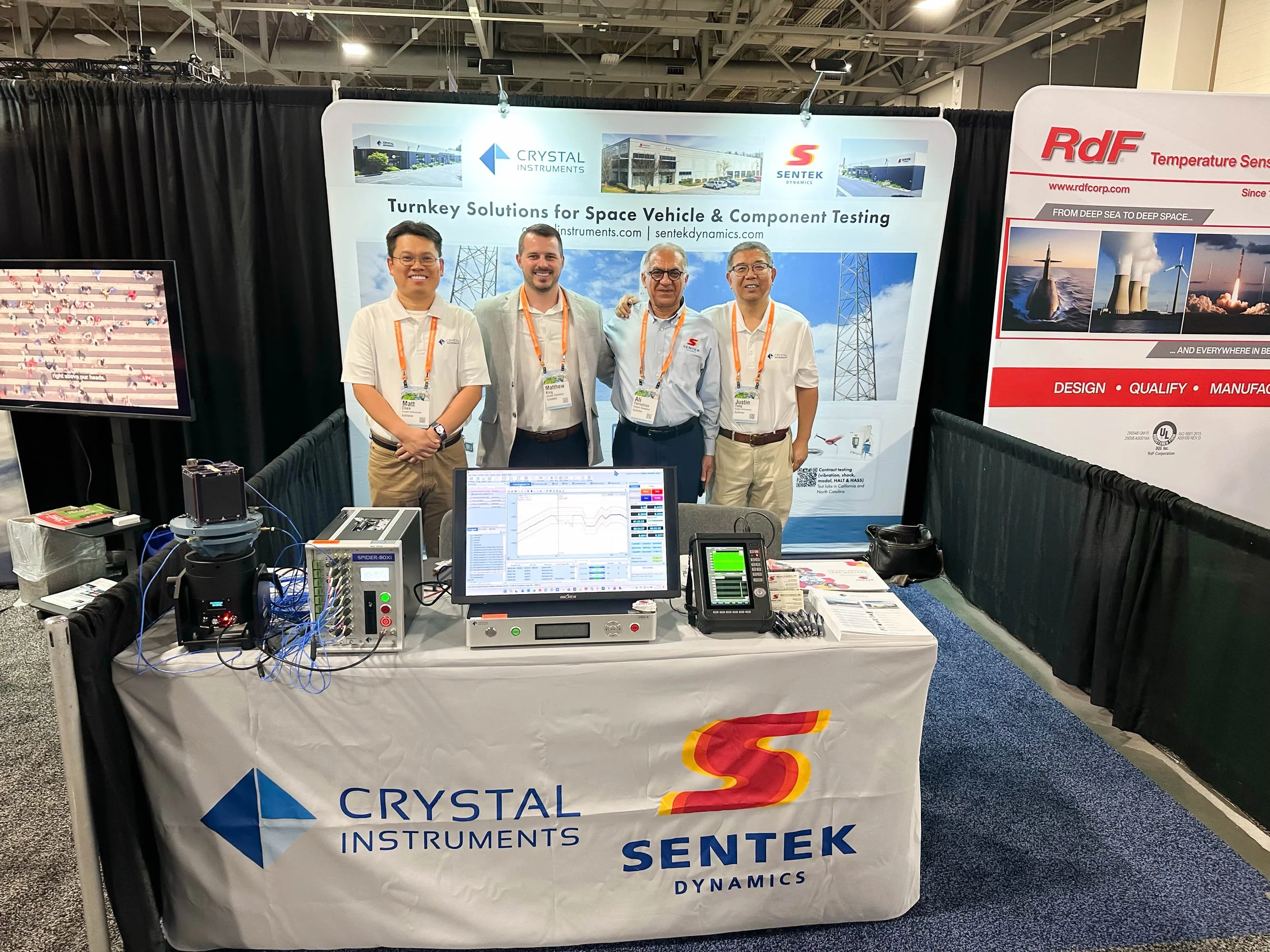
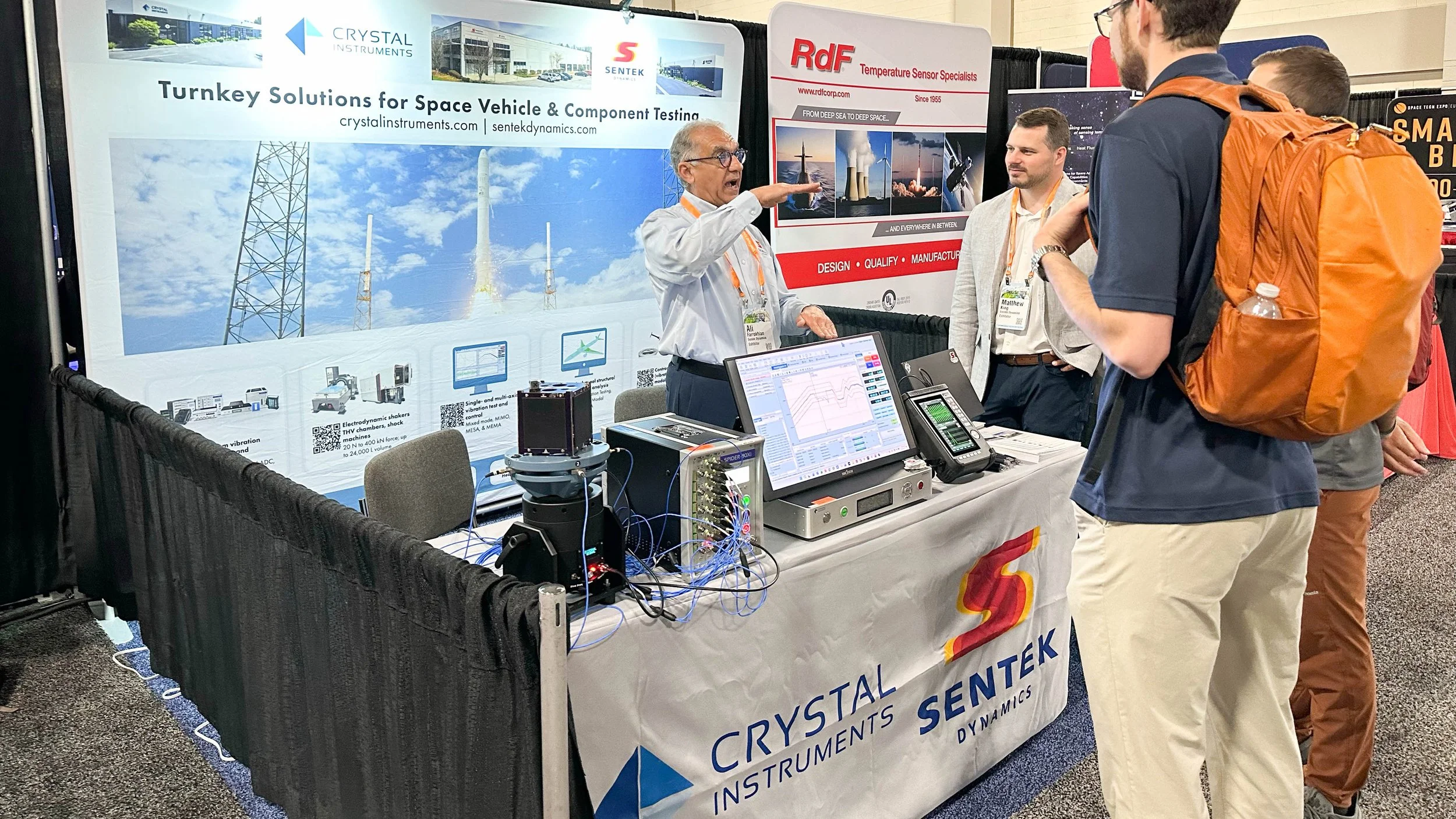
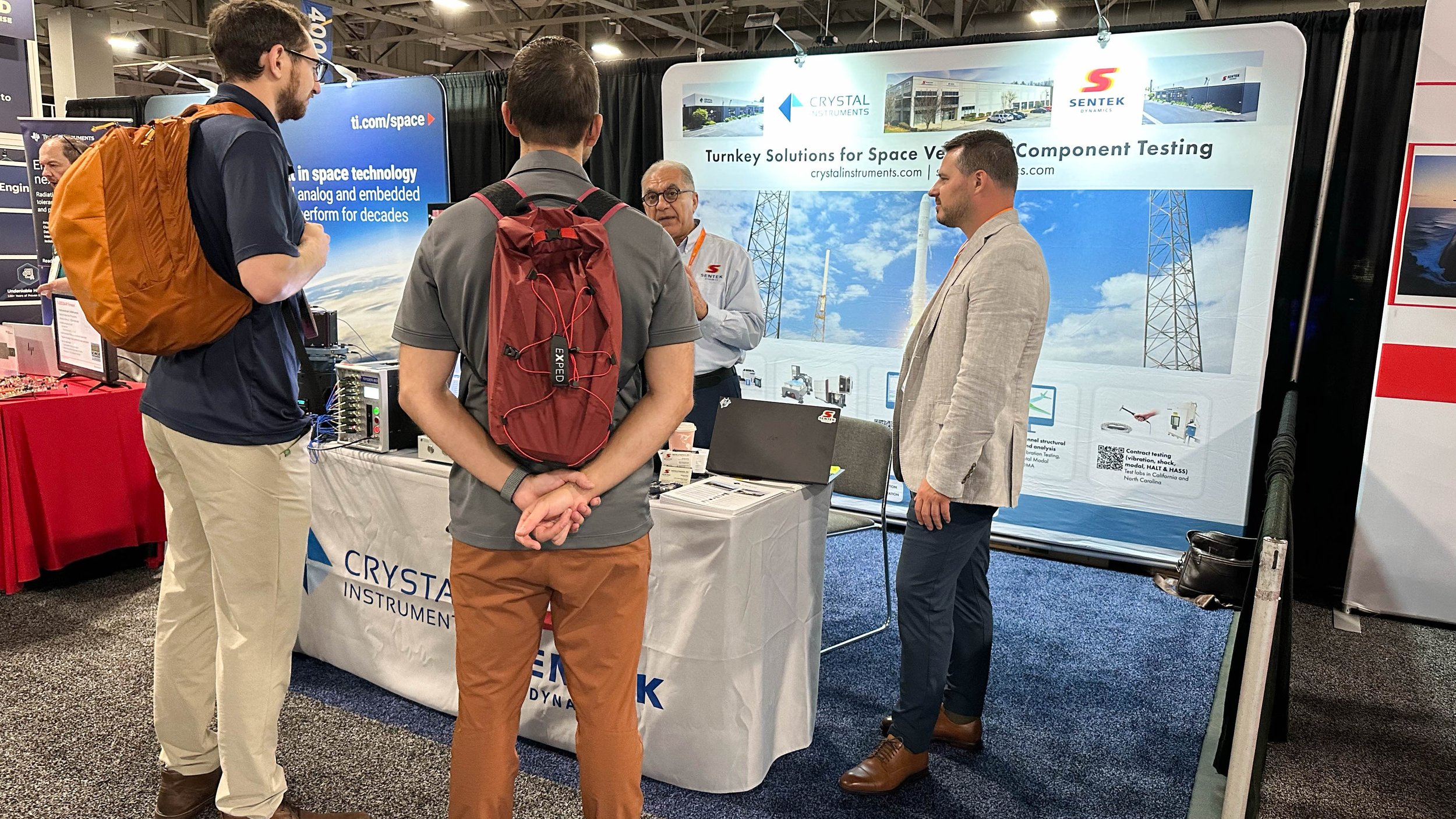
At the Crystal Instruments booth, attendees saw satellite vibration testing and dynamic measurement solutions designed to reproduce demanding launch environments, evaluate structural performance, and protect valuable flight hardware. A compact tabletop shaker and miniature satellite test article demonstrated how controlled vibration testing helps engineers understand how spacecraft structures and components respond to launch-induced loads.
Up to 512 Channels for Spacecraft Vibration Testing
Although the tabletop setup was small, it represented capabilities that scale to complex, high-channel-count spacecraft vibration tests. Crystal Instruments vibration control and data acquisition systems can support configurations of up to 512 channels, allowing engineers to monitor accelerometers, force transducers, and other measurement points across large test articles and fixtures. This channel capacity supports detailed analysis of localized responses while providing a coordinated view of the complete satellite structure.
Force Limiting Helps Prevent Satellite / Shaker Damage
Force limiting was a central feature of the satellite test demonstration. Traditional vibration control regulates acceleration at selected control locations, but a test article may experience overturning moment forces that exceed the vibration tables capacity. Force-limited vibration testing adds measurements from force transducers at the test article-to-fixture interface and reduces the shaker drive as defined limits are approached. This method helps prevent damage to the test article and shaker equipment while keeping the vibration test representative of the launch environment.
Advanced Limiting for Complex Spacecraft Structures
Crystal Instruments also supports summed channel limiting, which combines measurements from multiple channels. This approach is useful when the total force across several satellite interface points needs to be summed for moment-force calculation. Monitoring the combined result helps engineers identify overall structural loading that may not be apparent when channels are evaluated separately.
RSS vector sum limiting combines orthogonal measurements using a root-sum-square calculation. The resulting magnitude represents the overall vector response regardless of how the load is distributed among the measured axes. This direction-independent method is valuable when spacecraft loads shift between axes during a vibration test and no single-axis measurement fully describes the demand on the structure.
Overturning moment limiting is especially important for tall satellites and spacecraft with a high center of gravity. Forces measured at multiple mounting locations can be used to calculate the moment acting about the test article interface. Monitoring and limiting this value helps manage rocking that could place excessive stress on the satellite, vibration test fixture, or mounting hardware.
Together, force limiting, summed channel limiting, RSS vector sum limiting, and overturning moment limiting provide several ways to protect complex, high-value spacecraft hardware. These strategies complement acceleration control by accounting for loads transmitted through the fixture and the combined behavior of multiple measurement locations. Test engineers can select the limiting method that best represents the structural response and risk associated with a specific satellite vibration test.
Spider Vibration Controllers for Satellite Qualification Testing
The tabletop demonstration made advanced satellite vibration testing concepts easy to understand while highlighting the scalability of the Spider vibration control platform, including the Spider-81 and Spider-80Hi. From a compact satellite component to a large spacecraft instrumented with hundreds of channels, Crystal Instruments provides an integrated environment for vibration control, data acquisition, real-time monitoring, and test protection.
SmallSat 2026 gave the Crystal Instruments team an opportunity to meet engineers, researchers, government representatives, satellite manufacturers, and other professionals advancing the space industry. Ali Farrokhian, Matt Chen, Matt King, and Justin Tang spent the week connecting with new customers, reconnecting with existing contacts, and discussing the qualification testing challenges facing the next generation of small satellites.
Crystal Instruments looks forward to returning to the Small Satellite Conference and continuing to enhance its vibration control and data acquisition solutions for satellite and spacecraft development, qualification, and launch-readiness testing.