Frequency Response Function (FRF) is widely used in structural testing. Accelerometers are typically used and the acceleration vs. excitation force is measured as FRFs.
Read More
Frequency Response Function (FRF) is widely used in structural testing. Accelerometers are typically used and the acceleration vs. excitation force is measured as FRFs.
Read MoreCrystal Instruments and Sentek Dynamics presented products and technical presentations during Motion Fest in Israel on May 24, 2022. The event took place at a beautiful outdoor venue to facilitate the networking of over 200 users of Environmental Vibration Testing in the Israeli industry.
Read MoreSpyder is a popular IDE for Python developers in math and science applications. PythonNet is not included in Spyder’s pre-built packages, so the following steps need to be taken to install PythonNet in Spyder.
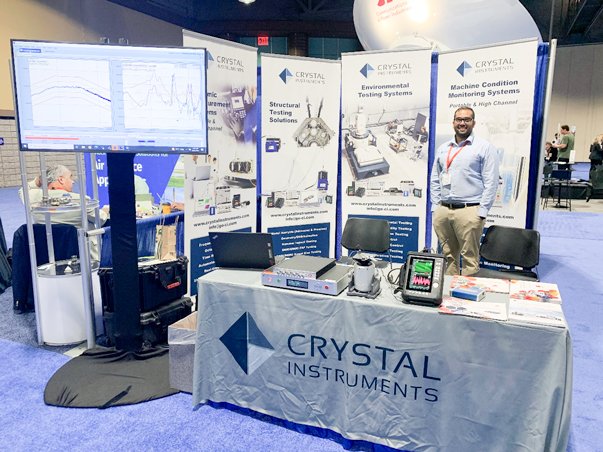
Read MoreCrystal Instruments and Sentek Dynamics presented products and solutions for environmental vibration testing at the 10th edition, Space Tech Expo USA at the Long Beach Convention Centre, California.
Read MoreThis paper concentrates on the MESA Sine on Random control per MIL STD 810H, method 514.8, annex D, 2.3 category 14. This category governs Sine on Random control for helicopters.
Crystal Instruments designed and released the Spider-80M Multiple-Exciter Single-Axis (MESA) vibration controller in 2018. Further details regarding the MESA testing system are available on the Sentek Dynamics website. Detailed product specifications may be requested from the Crystal Instruments team.
Read MoreThe ATFX API consists of two DLL files that can be integrated with custom software to directly read and extract data from an ATFX file. This post will show a simple C# code example in extracting and creating a DateTimeNano object that has accuracy in nanoseconds.
Read MoreThe ATFX API C# DLL files can be used in three supported coding languages: Python, Matlab and LabVIEW. For the C# DLL files to work in Python, a specific package that allows Python to integrate with .NET Common Language Runtime needs to be installed. There are several packages that do this, such as IronPython and Python.NET. For this example, Python.NET will be used.
Read MoreThe ATFX API consists of two DLL files that can be integrated with custom software to directly read and extract data from an ATFX file. This post will show simple C# code examples in opening and reading an ATFX file.
Read MoreWritten in collaboration between PCB Piezotronics, Inc., Crystal Instruments, and Team Icewave
Icewave has an overall record of seven wins and six losses. Marc DeVidts, Icewave creator and team lead, believes some of the losses may have been due to the blade not impacting opponents effectively. Because of the power behind Icewave, some of these losses can be attributed to self-inflicted damage from its own rotating horizontal blade. The modal testing will be used to help increase striking effectiveness.
Read MoreCrystal Instruments is pleased to announce the release of ATFX Signal Reader API, which is a set of DLL’s that allow third-party programmers to read data from ATFX files.
Read MoreRoam Robotics is a San Francisco-based company expanding human mobility with wearable robotics focused in three areas: recreation support, medical orthotics, and military applications.
Each application requires a thorough investigation to ensure user safety and comfort. Crystal Instruments is proud to provide the four channel Spider-20E dynamic signal analyzer for Roam to perform acoustic testing on their products.
Read MoreThe experimental object in this modal test is a hood cross-flow fan with an overall structure that includes a roulette wheel, rotor frame and cross-flow blades that are composed of metal materials. The fan is hung using bungee cords to imitate free-free boundary conditions.
Read MoreShock Response Spectrum (SRS) testing is commonly required for defense applications. The UUTs are tested under significantly high levels of shock waveforms.
The concept of SRS predictive notching was proposed a few years ago to fully test UUTs and ensure their survival experiencing real-world vibrations while protecting it from over testing.
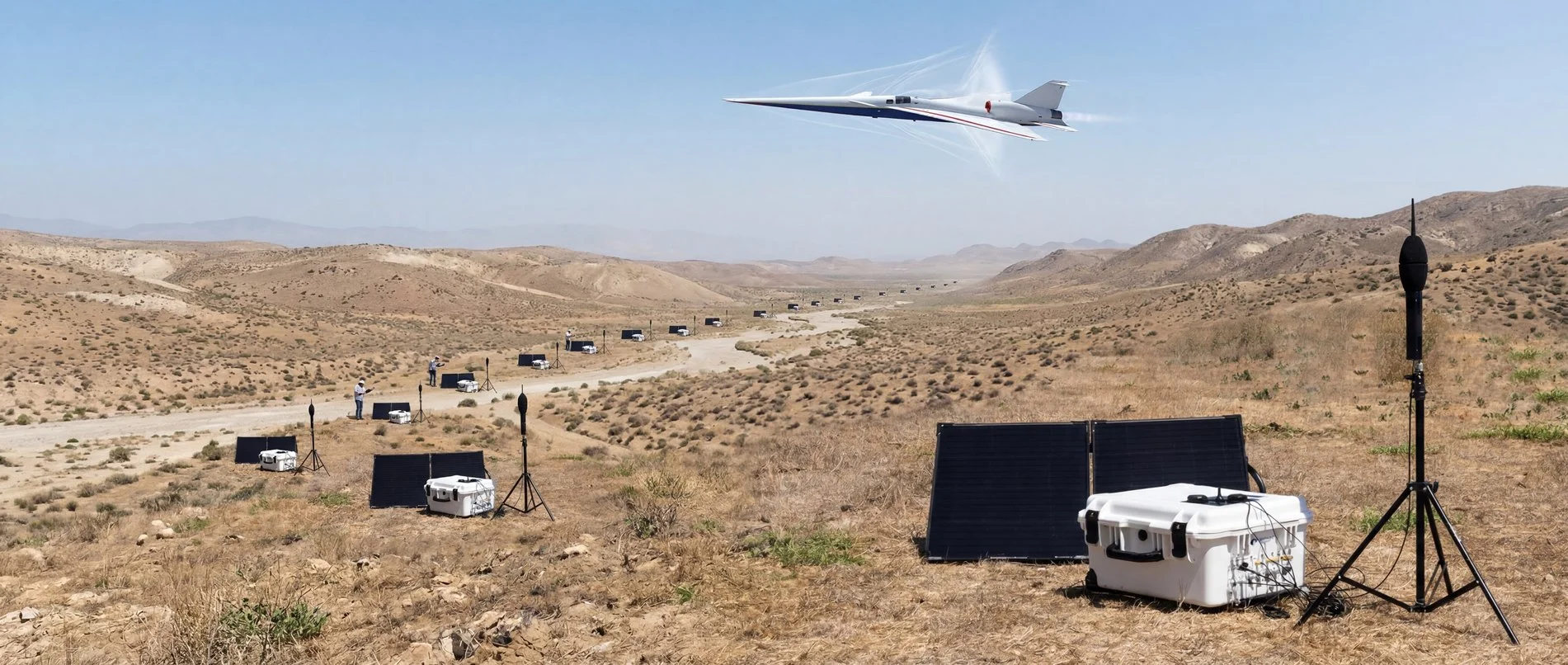
Read MoreNASA’s response to Crystal Instruments addressed items NASA found beneficial, items NASA wanted changed, and items NASA benchmark tested on the prototype units. The Crystal Instruments prototype GRS systems were delivered according to a contractual agreement and performed well when tested for each listed specification with some areas of improvement.
Read MoreAmplitude precision is a simple specification that quantifies a channel’s amplitude error. The error is the difference between the nominal input amplitude and the channel’s measured amplitude.
Amplitude linearity is a way to specify the precision over a range of nominal input amplitudes. Precision typically depends on the input amplitude, and when just one number is provided for the amplitude precision specification, it is usually at 1 kHz and 1 V.
Read More