
Highlights from the AIAA Aviation Forum featuring the Ground Recorder System and NASA’s X-59 Aircraft
The AIAA Aviation Forum is where aerospace engineers gather to push the boundaries of what flight can become, and Crystal Instruments was proud to be part of that conversation this year. We brought our latest dynamic measurement and data acquisition hardware to showcase, and we had one extraordinary story to tell: how the Ground Recorder System (GRS) played a role in a genuine milestone in aviation history.
Breaking the Sound Barrier Again
NASA's X-59 quiet supersonic research aircraft broke the sound barrier for the first time on Friday, June 5, 2026. The X-59 is the centerpiece of NASA's Quesst mission, designed to demonstrate that supersonic passenger flight over land doesn't have to rattle windows and shake communities. Instead of the sharp crack of a conventional sonic boom, the X-59 is engineered to produce a much quieter "thump", closer to a distant rumble than an explosion.
Measuring that acoustic signature accurately and reliably is everything. If you can't capture the sound field on the ground with precision, you can't validate the aircraft's performance or build the case for regulatory change. That's where the GRS came in.
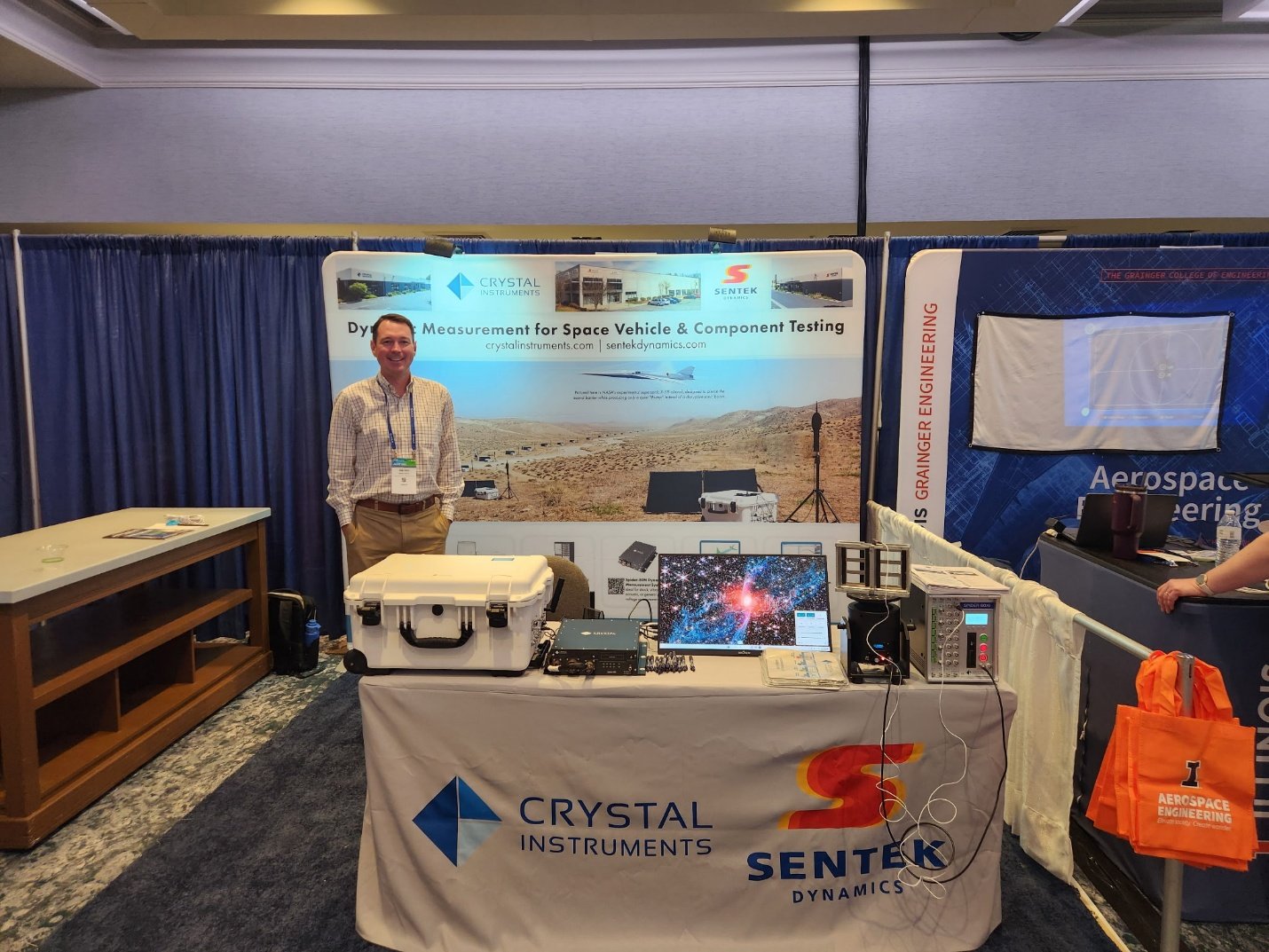
Darren Fraser (Vice President of Sales) at the AIAA Aviation Forum
"Being part of a program like the X-59 is exactly what we build for. When NASA needs to characterize a supersonic acoustic footprint across a wide area with no infrastructure and no margin for error, that's where the GRS proves itself. It was gratifying to bring that story to the Aviation Forum and have engineers immediately understand why it matters for their own programs."
— Darren Fraser, Vice President of Sales
The GRS: Built for Where Data Happens
The Ground Recorder System isn't a lab instrument pressed into field service, it was designed from the ground up for exactly this kind of deployment. Rugged. Weatherproof. Self-sufficient.
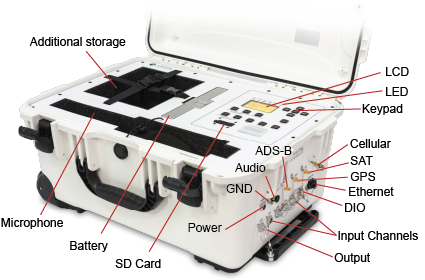
Ground Recorder System (GRS): Purpose-Built for Remote Aerospace Measurements
The enclosure carries an IP67 rating and is built to handle high winds, dust, and heavy rain. Its operational temperature range runs from -20 °C to +55 °C, and it can power on and run after cold soaking at 0 °F for 24 hours or longer. The GRS excels in outdoor deployments far from infrastructure such as open deserts, airfield perimeters, and remote monitoring sites. The GRS can run on solar power to recharge its dual 94 Wh Li-ion batteries continuously for unattended operations lasting from days to weeks.
The measurement core is equally impressive. Four input channels, each serviced by two 24-bit ADCs, implement our patented dual-ADC technology (US Patent No. 7,302,354) to achieve better than 150 dBFS dynamic range. For acoustic work, that headroom matters: capturing both the ambient noise floor and the peak event in a single recording, without clipping or missing detail, is exactly what the GRS delivers.
GPS time synchronization is where the GRS becomes something genuinely unique. A built-in GPS receiver timestamps data at the ADC clock level to achieve 100 ns accuracy or better (US Patent No. 11,611,946). When multiple GRS units are deployed across a wide area, each one time-syncs independently to GPS. EDM PA post-processing software then aligns all of those time streams to a common reference, making it possible to compute frequency response, phase, cross-spectrum, and coherence functions between sensors separated by miles with no direct cable or network connection between them. For the X-59 program, that capability enabled a distributed ground sensor network that could characterize the aircraft's acoustic footprint across a large area simultaneously.
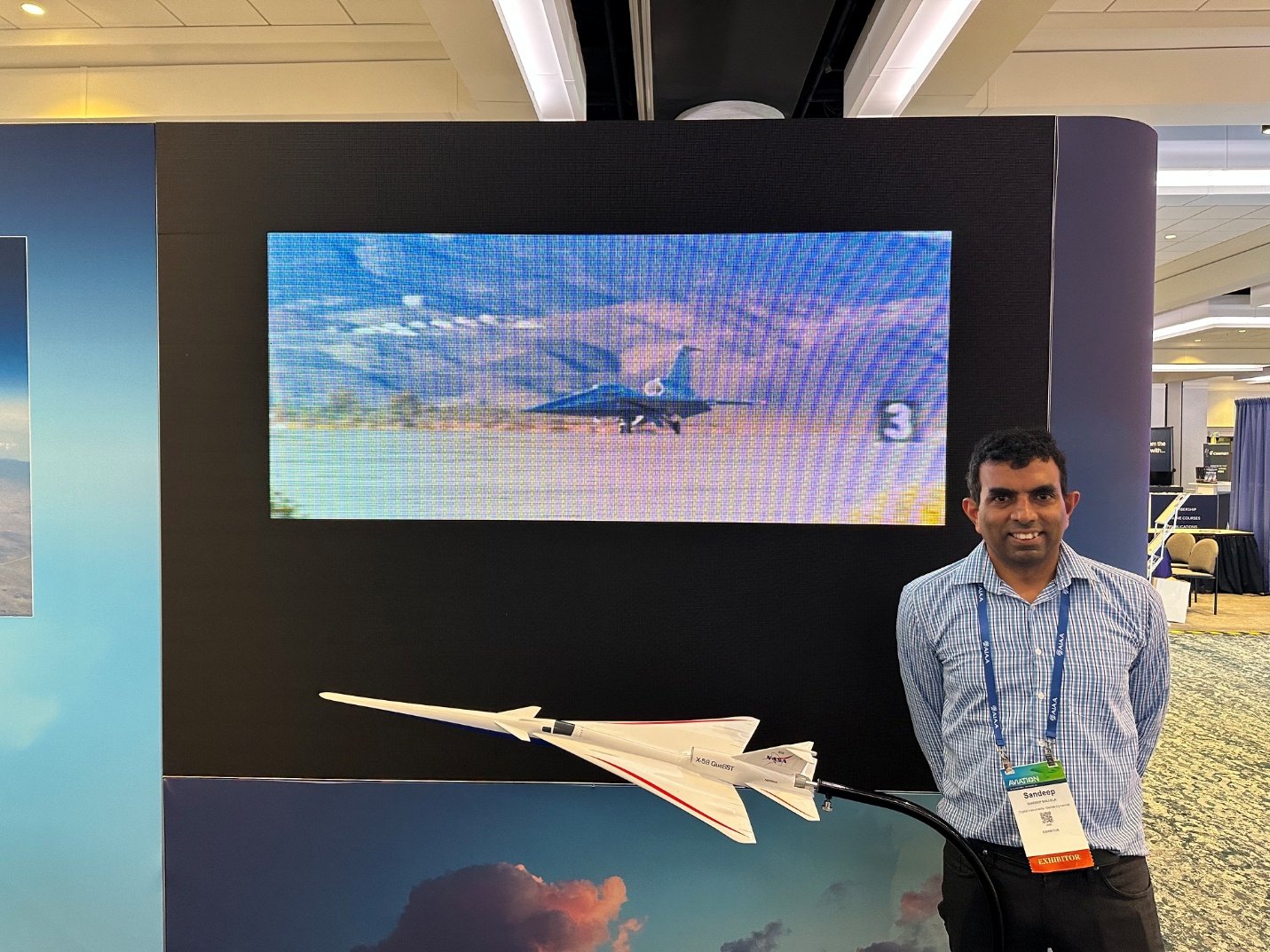
Sandeep Mallela (Director of Engineering) with an image of NASA’s X-59 aircraft
"The X-59 application is a good example of what our time-stamping architecture was designed for. You have distributed sensors with no physical connection between them, an aircraft traveling at supersonic speed, and a requirement to reconstruct the acoustic field with nanosecond-level timing accuracy. That's not a software problem you can patch after the fact has to be solved in hardware, and that's exactly what we did."
— Sandeep Mallela, Director of Engineering
Additional features that mattered for this mission:
ADS-B receiver — the GRS can track aircraft in a 200-mile radius, capturing position and identity data alongside acoustic recordings. This allows recordings to be correlated precisely with overflight events, enabling triggered capture tied directly to aircraft arrival.
Triggered recording with circular buffer — the system can hold up to 150 seconds of pre-trigger data in memory, so when the aircraft passes overhead and the trigger fires, nothing from before the event is lost.
FIPS 140-2 encryption — all data on the SD card can be encrypted to government security standards, important for mission-critical programs.
Scheduling and autonomous operation — a master schedule function lets the GRS run a sequence of actions without human intervention: arm, record, post-process, sleep, wake, repeat.
The GRS has also been tested and qualified to IEC 60068-2-27 shock and vibration standards, including 50 g half-sine shock and 5 grms random vibration, ensuring the hardware survives transport and field conditions without compromising data integrity.
Spider-80N: Ruggedized, High-Channel Recording for Demanding Environments
Also on display at the forum was the Spider-80N ruggedized front-end system designed for long-duration, high-density data acquisition in harsh environments.
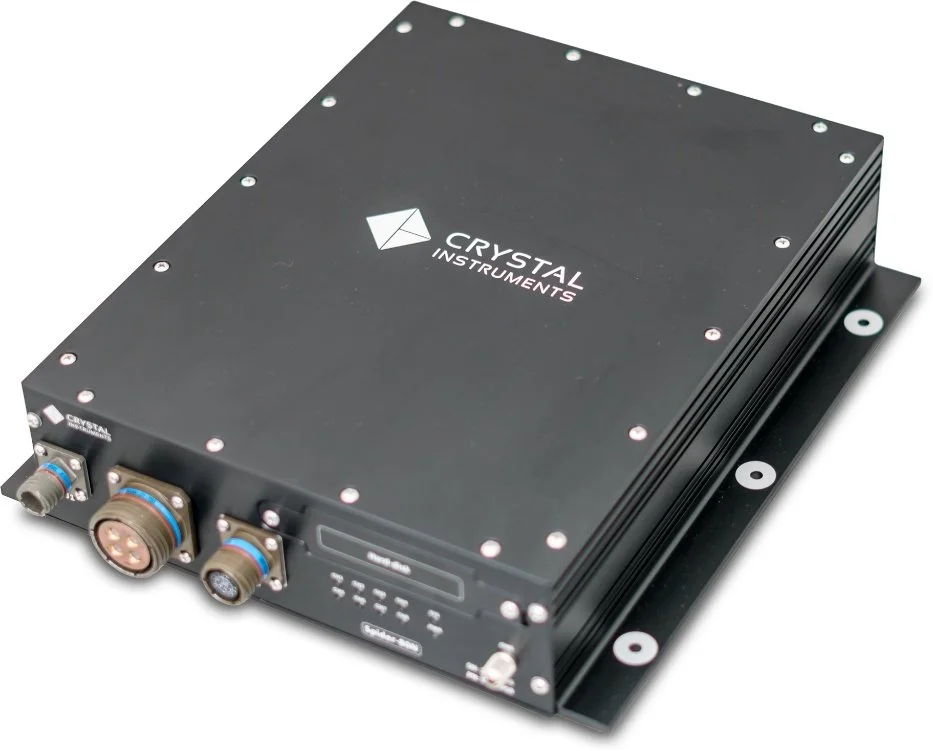
Spider-80N, a ruggedized dynamic measurement system
The Spider-80N combines the proven signal quality of the Spider-80X front-end with an integrated solid-state drive (Spider-NAS), all in a single unit rated for military-standard environments. Key capabilities include:
8 input channels with 160 dBFS dynamic range, the highest in class among comparable systems
204.8 kHz maximum sampling rate per channel, with continuous recording to an on-board SSD of up to 4 TB
Up to 360 hours of recording at 51.2 kHz, or 90 hours at full 204.8 kHz bandwidth
MIL-STD 461G and 704D compliance, making it suitable for avionics and military platform integration
Black Box mode — the Spider-80N can run a pre-programmed schedule autonomously after boot, with no host PC required
Operational from -54 °C to +55 °C, with water pipe and heat sink cooling and no cooling fan required
For aerospace and defense programs requiring long-duration unattended recording such as flight test instrumentation, structural health monitoring on platforms, or continuous condition monitoring, the Spider-80N delivers lab-grade signal quality in a package engineered for the real world.
Spider-80Hi: High-Bandwidth, High-Channel Scalability
Rounding out the hardware showcase was the Spider-80Hi, the front-end module for the Spider-80Xi modular, scalable system built for high-channel-count dynamic signal analysis.
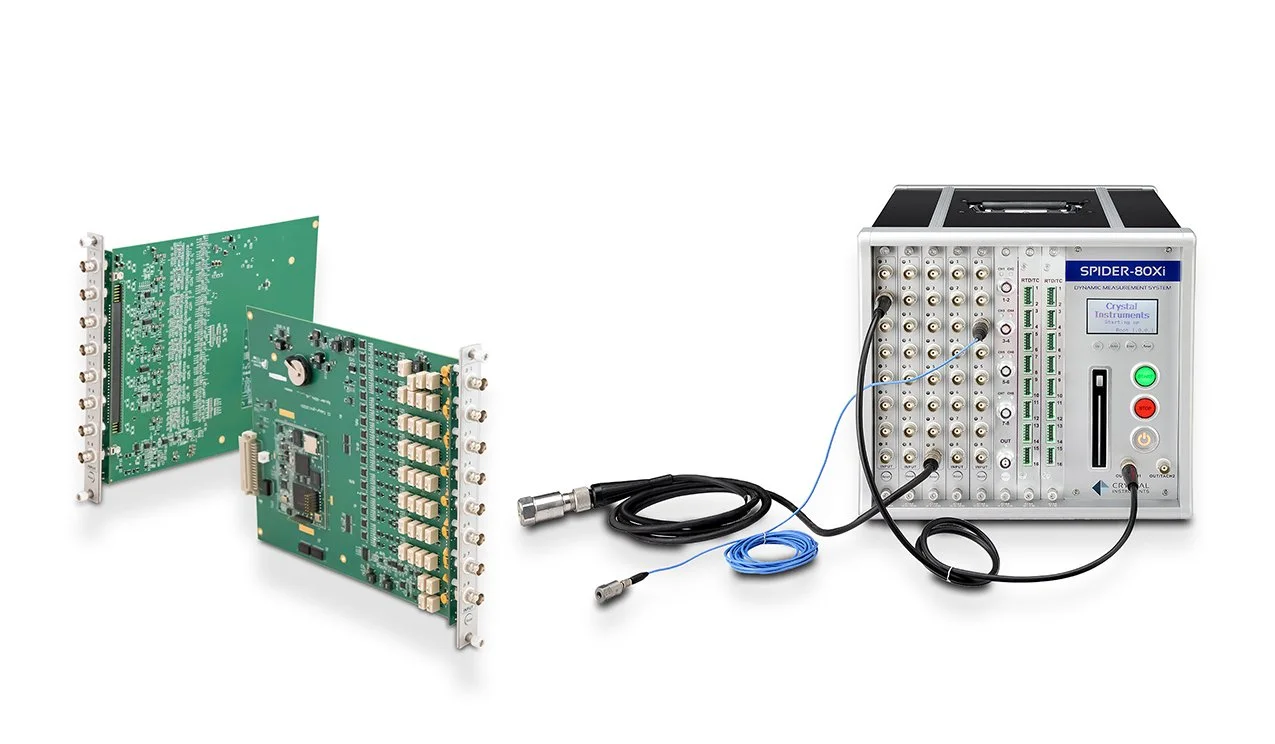
Spider-80Hi: High-Channel-Count Data Acquisition
The Spider-80Hi pushes the performance envelope with a sampling rate of up to 512 kHz and a dynamic range exceeding 175 dBFS by utilizing Crystal Instruments’ patented dual 24-bit Σ-Δ ADC technology. Powerful features include:
8 input channels per module, scalable to 1,024 channels across multiple interconnected Spider-80Xi chassis
BNC connectors with IEPE/ICP support, single-ended and differential input modes, and ±220 V input protection
Two output channels with 32-bit DAC resolution and up to 512 kHz output rate enable simultaneous acquisition and excitation at extreme bandwidths
IEEE 1588v2 time synchronization between modules, with phase match better than ±1° at 40 kHz
GPS and PTP Grandmaster Clock support for time stamping, enabling cross-spectral analysis between geographically distributed systems
THD of -105 dB at 1 kHz, crosstalk better than 120 dB, and amplitude channel match of less than 0.04 dB
The Spider-80Xi chassis is available in 4-slot (DC powered, field-portable) and 8-slot (AC powered, up to 64 channels per chassis) configurations. Multiple chassis interconnect to build systems from 16 to 1,024 channels all sampled simultaneously and phase-matched. For modal testing on large aerospace structures, acoustic array measurements, or multi-point vibration qualification testing, the Spider-80Hi platform provides the bandwidth, channel density, and synchronization accuracy to match the measurement challenge.
Precision Measurement for the Next Era of Flight
From X-59 overflight characterization to structural qualification testing on next-generation airframes, the measurement challenge in aerospace is always fundamentally the same: capture what's actually happening accurately, reliably, and under conditions that would compromise lesser equipment.
Crystal Instruments builds measurement systems for the conditions that actually exist in the field, not the ideal ones. The GRS is designed for remote, unattended deployment where power and infrastructure can't be assumed. During the X-59's first supersonic flight, the GRS worked flawlessly to capture every acoustic event with precision. In fact, one of the booms recorded turned out to be from the F-15 chase plane, which also went supersonic during the flight. That kind of fidelity, capturing an unplanned event cleanly in the field without any intervention is exactly what the system was built to deliver. The Spider-80N brings military-grade ruggedization and long-duration recording capacity to programs that can't afford data gaps. The Spider-80Hi delivers the channel density and bandwidth that large-scale structural and acoustic programs demand. Each system is different in form, but the underlying commitment is the same: the highest dynamic range available, patented signal processing technology, and hardware engineered to work where the data actually lives.
We're grateful to the AIAA Aviation Forum community for the conversations, the questions, and the shared commitment to advancing the science of flight measurement. If you'd like to learn more about any of these systems or discuss how they might fit your program requirements, contact us.
Learn more about the NASA X-59 first supersonic flight at nasa.gov. Learn more about the AIAA Aviation Forum at aviation.aiaa.org.