
'Listening' to Cape Canaveral: Crystal Instruments at NoiseCon 2026
Crystal Instruments Eastern Regional Sales Manager Brian Zatzkin will be presenting at NoiseCon 2026 in Long Beach, California to share the story of how GPS-synchronized distributed data acquisition turned a mystery of cracking windows into a landmark structural acoustics dataset.
His talk, "GPS-Synchronized, Large-Scale Measurement of Structural and Acoustic Response to Next-Generation Launch Vehicles at Kennedy Space Center," is scheduled for Sunday, June 28 from 4:30–4:40 PM in the Community Noise – Aircraft Noise session (Barcelona/Casablanca room).
It Started with Cracked Windows
When contractors working onsite at Kennedy Space Center identified growing cracks in the windowpanes in a roughly 60,000-square-foot multi-use structure about two miles from Kennedy Space Center's launch pads, they ruled out the obvious culprits. No earthquakes. No storms. The cracks tracked with launch and landing activity, and yet no measurement data had ever been captured during those events.
"We were wondering what we don't know". That question set a measurement program in motion.
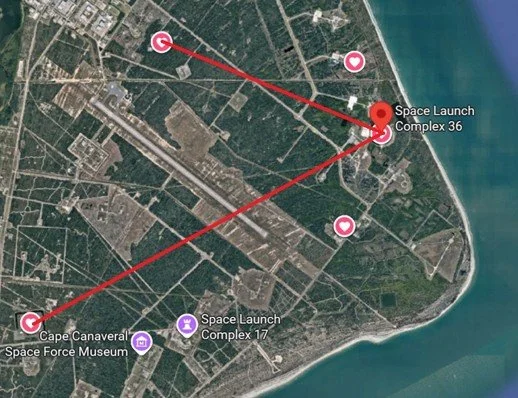
KSC Facility # 1 – top left (≈60,000 sq ft)
KSC Facility #2 – bottom left (≈130,000 sq ft)
Images from Google Maps
A Fundamentally Changed Energy Environment
Modern launch vehicles don't just launch, they land. That shift has altered the acoustic and structural loading environment around the pads in a significant way. A traditional rocket launch produces a long-duration broadband acoustic rumble: sustained energy over many seconds, historically the dominant structural concern. A booster landing is something else entirely. It is a brief, extremely high-intensity event as the vehicle goes supersonic again on the way down, breaking the sound barrier at 30,000 to 40,000 feet and generating three distinct sonic booms from the nose, base, and grid fins. Estimated sound pressure levels at two miles from the landing pad reach approximately 115 dB SPL.
Capturing both types of events and understanding how a large building responds to each required a measurement approach that didn't yet exist at this site.
The Measurement Problem
Three constraints defined the challenge:
The landing impulse lasts a fraction of a second. You capture it on that pass, or not at all. The building's response spans hundreds of feet, from roofline to fence line, requiring sensors across a large physical footprint. And dozens of channels distributed across a structure must share a single, trustworthy clock to produce data that is directly comparable.
A first measurement campaign using three portable 8-channel CoCo-80X recorders proved the problem was real but the workflow was painful. Crews had to hit record and evacuate before the exclusion zone was activated, with no way to monitor or control acquisition remotely. Aligning channels from separate units meant exporting spreadsheets and matching clocks by hand.
Two requirements became clear: remote operation from outside the exclusion zone, and hardware-level time synchronization across all devices.
The Solution: Spider-80Hi with GPS Time Sync
The team selected Crystal Instruments' Spider-80Hi distributed data acquisition platform. Each Spider-80Hi chassis carries its own GPS-disciplined clock, locking to better than 60 nanoseconds so the system can scale across separate buildings without running cables back to a centralized chassis. Units on a shared Spider-HUB switch synchronize via IEEE 1588v2 to better than 100 nanoseconds, with phase match under ±1° at 20 kHz.
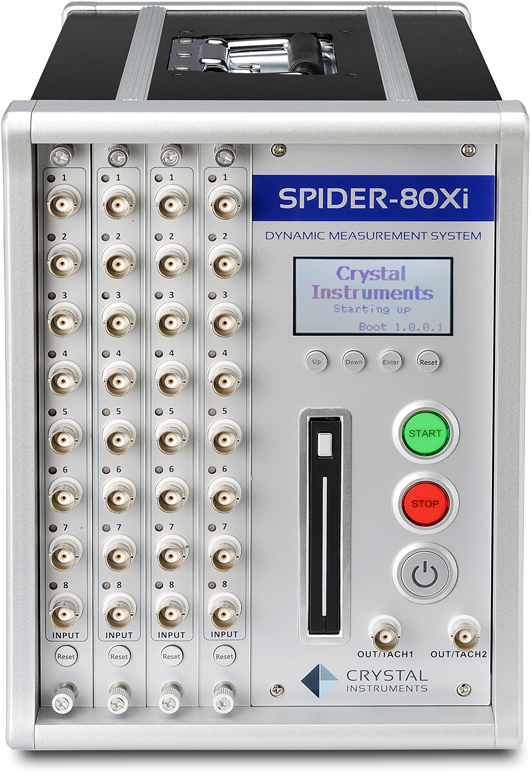
32 channel Spider-80Hi data acquisition system
The Phase 2 deployment fielded 32 channels which consisted of four 8-channel IEPE cards per chassis, capturing accelerometers for structural vibration and microphones for the acoustic field simultaneously. Sensor cabling radiated from a single control point near the building entrance out to every response surface of interest: the roof, the windows where cracking first appeared, the entry doors (which were observed visibly flexing under the sonic boom), and free-field microphone positions around the perimeter.
The time-alignment problem that had required hours of manual spreadsheet work was eliminated. Channels are aligned the instant they were recorded. Analysis can begin the same day.
What the Data Showed
The results were significant. Measured acoustic and structural response levels came in roughly an order of magnitude higher than the launch provider's published predictions. Spatial variability across the building was substantial. These differences would have been invisible without dozens of channels captured simultaneously on one timeline. An independent third-party acoustics analysis independently predicted levels above the provider's estimates as well.
Scaling the Capability
A distributed data-acquisition and analysis platform where each chassis carries its own clock, so the system scales across any number of locations or buildings, instead of forcing every cable back to a single chassis.
A distributed data-acquisition and analysis platform where each chassis carries its own clock, so the system scales across any number of locations or buildings, instead of forcing every cable back to a single chassis.
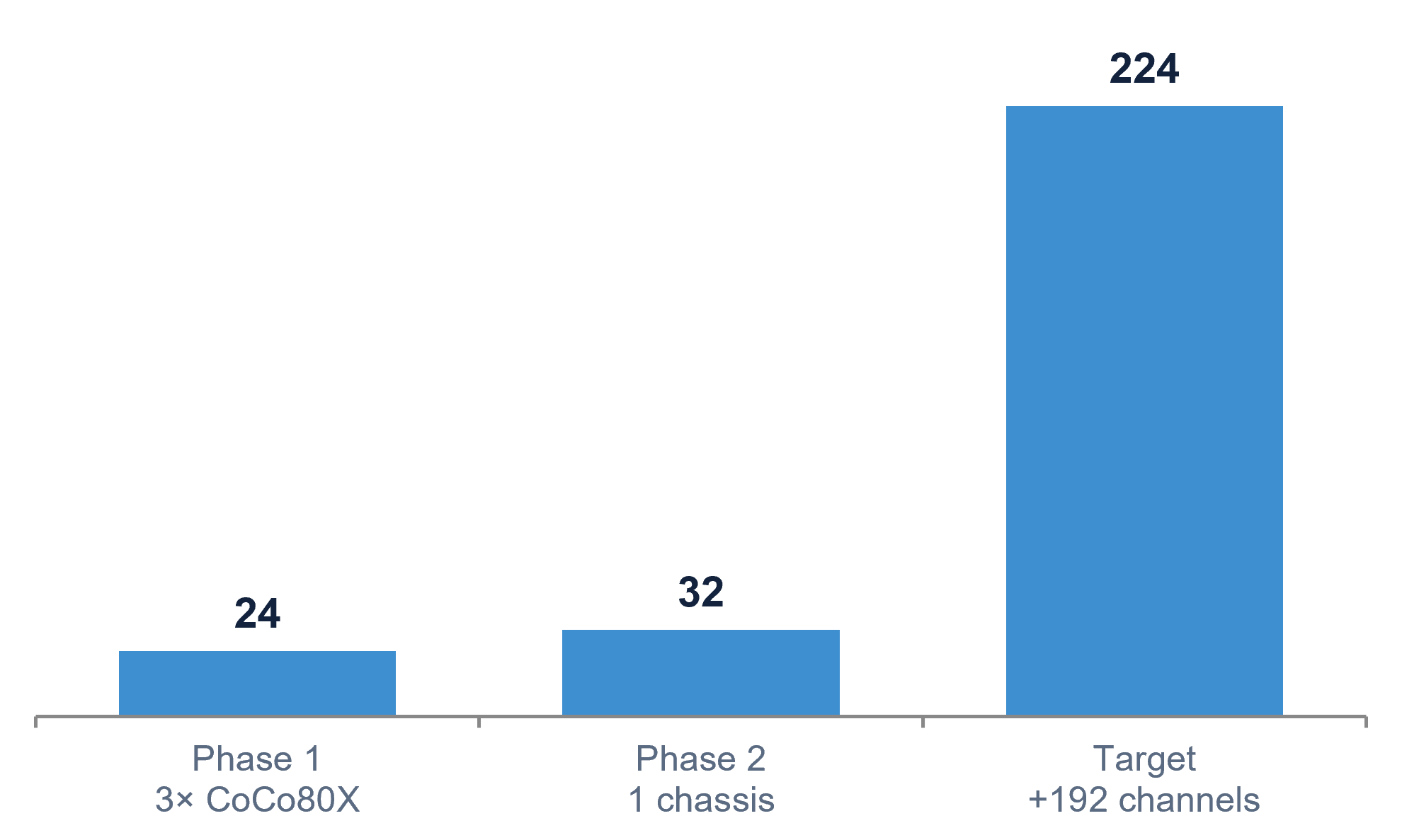
The program has continued to grow. This group has now standardized on the Spider-80Hi chassis as a repeatable building block. One configuration to document, one unit to calibrate, the same module deployable anywhere. From the initial 24-channel portable campaign, through the 32-channel GPS-synchronized Phase 2 deployment, the program is heading toward a permanent 224-channel rack-mounted installation in a building of approximately 130,000 square feet. The longer-term goal is a fully deployable system that can be taken to any facility.
"The equipment is easy to use, the company is easy to work with, and it's built and supported here in the USA."
Brian's NoiseCon talk covers the full arc of this program from the first cracked window to a standing measurement capability. If you're attending NoiseCon 2026, the session runs on Sunday, June 28 at 4:30 PM in the Barcelona/Casablanca room. You can find the full conference program at noisecon2026.org.